In 1861, the British introduced Section 377 that decriminalised sexual activity committed “against the natural order.” This law of the Indian Penal Code changed the landscape of India. For it did not just declare “unnatural” association illegal, it forced Victorian morality and Biblical norms in a country that had acknowledged the existence of queer community since ancient times. The ancient Indian scriptures and temples record the evidence of homosexuality in ancient India. From ancient scholars like Patanjali and Bhartrhari to modern-day academicians like Devdutt Patnaik and Renate Syed, all agree on the existence of tritiya prakriti (third nature/gender) in ancient Indian society. Let’s go down the history to uncover the queer history of ancient India.
Homosexuality in Ancient India
Rig Veda
The Rig Veda is the first and oldest of the four Vedas. The statement “Vikriti Evam Prakriti” mentioned here refers to the fluidity of gender identity and emphasizes the naturalness of the existence of the third gender in society. It recognizes three genders – purusha (males), stri (females), and tritiya prakriti (third gender). Another instance records the Vedic Gods Varun-Mitra as same-sex couples, who represent the two halves of the moon. It says they plant their seed in each other to start the waning and waxing phases of the moon. Shatapatha Brahmana writes as well, “On that new moon night, Mitra implants his seed in Varuna, and when the moon later wanes, that waning is produced from his seed. Varuna is similarly said to implant his seed in Mitra on the full-moon night for the purpose of securing its future waxing.”
Ramayana
Interestingly, Ramayana narrates three such instances involving same-sex relations and transvestites or hijras. In Krittivasa Ramayana, a 15th-century Bengali adaptation of Ramayana, Bhagiratha, one of the ancestors of Lord Rama and known for bringing down the sacred Ganga or Bhagirathi river to earth, was born of two women. The legend narrates that King Dilipa died without an heir, leaving behind two widows. They came together with the blessings of Lord Shiva and gave birth to Bhagiratha.
In another episode, when the monkey god Hanuman enters Lanka to find Sita, he encounters two rakshasas in an intimate embrace, kissing each other. The third instance occurs when the people of Ayodhya follow Rama, Sita, and Laksmana when they leave for exile. He orders ‘all men and women’ to return to their homes. When he returns after fourteen years, he finds hijras or transvestites sitting in the same position for all these years. Pleased with their dedication, Lord Rama blessed them and prophesied that they would bless humanity on auspicious occasions.
Mahabharata
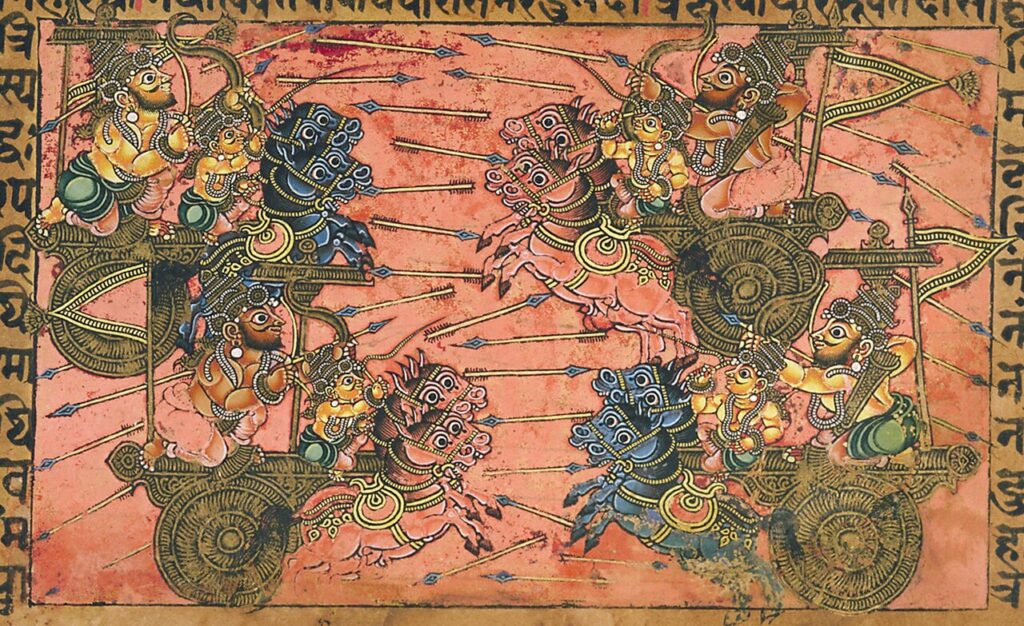
Shikhandini, or Shikhandi in the Mahabharata, is one of the most famous transgender figures in the epic. Shikhandini was the sister of Draupadi, born as a woman to King Drupada but raised as a man. She was the reincarnation of Amba, whom Bhishma had won in a swayamvara for his brother. But when he learned about her love for King Salva, he let her go. However, the ruler refused to marry her since Bhishma had rightfully won her hand. Humiliated, she returned to Bhishma, asking him to marry her. He refused to grant her wish due to his vow of celibacy. Insulted and enraged, she cursed him and promised to be the cause of his downfall. In her next life, Amba was born as Shikhandini. King Drupada married Shikhandini to a princess, who discovered her ‘husband’ was female on their wedding night. Later, she exchanged her sex with a yaksha and turned into a man, Shikhandi. During the Kurukshetra war, Bhishma recognized Shikhandi as Amba and refused to attack her, hence providing Arjuna with the opportunity to bring down the great warrior.
In another instance, Arjuna was cursed to become a kliba (impotent or eunuch) by apsara Urvashi when he refused her advances. This turned out to be a perfect disguise for his last year in exile. He adopted the name Brihannala and dressed in female attire to live his life as a transgender music teacher at the court of King Virata.
During the Kurukshetra War, a human sacrifice was needed, and Aravan, son of Arjuna and Naga princess Ulupi, volunteered for the cause. Before the sacrifice, Lord Krishna asked Aravan about his last wishes, one of which was to get married. To grant his wishes, Lord Krishna took the female form of Mohini. They got married, and after his death, Mohini grieved Aravan like a widow. Today, transgender people of Koovagam village celebrate the Koovagam festival for 18 days to recreate the marriage of Aravan and Mohini and to honour his sacrifice.
Homosexuality in India Today
These examples prove the existence of queer people and homosexuality in ancient India. While some of the ancient Indian scriptures lay down punishments for intercourse between two males or females, they acknowledge the existence of this community in ancient Indian society. Additionally, one of the eight types of marriages of ancient times, the ‘gandharva marriage’, included same-sex marriage. It was a love marriage where parents’ approval was not needed.
When the British declared same-sex relationships illegal, they cast a shadow on the roots of India and forced the morals and regulations of their country here. The Supreme Court ruling of 2018 decriminalized same-sex relations in India. It struck down Section 377 after over 157 years, when the British introduced it in the Indian Penal Code. However, the passing of the Transgender Persons (Protection of Rights) Amendment Bill in March 2026 is a step back in the advancement of LGBTQIA+ rights. This bill does not allow the people of this community to ‘self-identify’ as queer, necessitating a medical certificate for recognition. While the gender norms and concepts of ancient India were quite different from the modern definitions, the people of queer community were acknowledged in ancient society, and any ruling in favour of them would be a step towards connecting India with its roots.