Daag acche hote hai! And this Indian heritage proved it. Chintz or calico (derived from chint, meaning spotted or variegated) originated in India about 4000 years ago. But it was only during the late medieval and early modern period that it became a global phenomenon. Indian expertise in printed cotton cloth production and its quality made the world a fan of Indian textiles. From Europe to Africa, this textile revolutionized the clothing and home decor industries. Chintz is not only a product of expert Indian craftsmanship but a story of colonialism, slavery, oppression, exploitation, and destruction. Let’s unfold the journey of chintz from India to the far corners of the world.
Calico Craze
The Portuguese were the first Europeans to take chintz to the global stage. Earlier, Indian textile merchants traded with Arab and Turkish merchants, who in turn sold it to European buyers. But when Vasco da Gama landed at the port of Calicut in 1498, it was the beginning of a new era. Historian Sven Beckert highlighted that da Gama returned to Portugal with Indian cottons alongside spices. The journey of the Portuguese to India had led to the discovery of sea routes that would allow the Europeans direct access to India, eliminating Arab and Turkish middlemen (1).
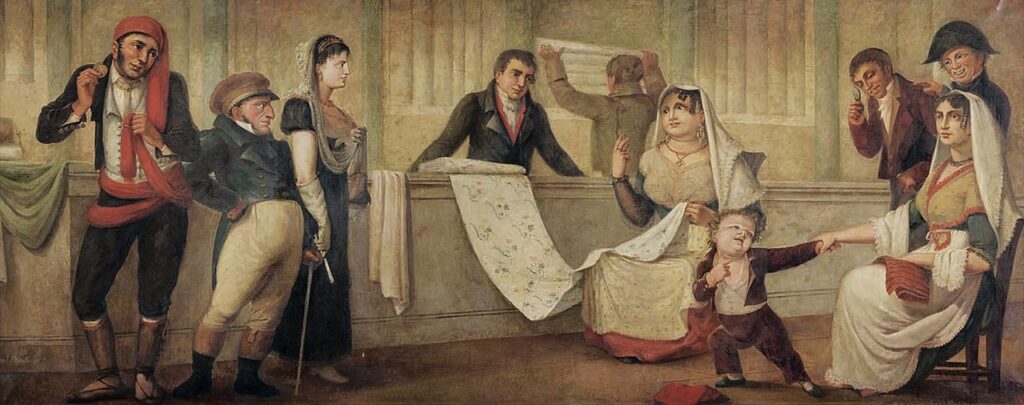
The arrival of chintz in Europe changed the fashion and home scenario in Europe. It was unlike the fabrics available in European markets; lighter, more comfortable, colorful, and more affordable compared to wool and silk. Soon, this gave birth to the ‘calico craze’ in the West. From the royal to the locals, everyone used chintz in their homes. Before breaking the fashion industry, calico was first modeled in home decor. The English writer Daniel Defoe commented in ‘The Review’ that calico has ‘crept’ into their houses and taken over curtains, closets, cushions, bed-chambers, and beds; and anything that was made from wool or silk, from women’s dresses to home furniture, is now dependent on Indian trade (1).
In the middle of the 17th century, the chintz was adapted into fashion. In England and Spain, working women wore chintz made from the leftover furnishing fabric. In the 1670s, chintz clothes became highly sought after by the royalty. The East India Company sent customized designs to Indian artisans to make chintz for European markets feel exotic and aesthetic. This included English embroidery patterns, Islamic floral styles, and Chinese ceramic designs. The European chintz was often curated on white fabric, as Chinese porcelain was in vogue at the time.
Today, the Calico Museum of Textiles displays an assortment of Indian textiles from around the world. It shows Indian heritage, religion, beliefs, traditions, and history through textiles and its designs.
Sources
1. ‘The floral fabric that was banned,’ BBC, https://www.bbc.com/culture/article/20200420-the-cutesy-fabric-that-was-banned
2. Calico Museum of Textiles, https://calicomuseum.org/