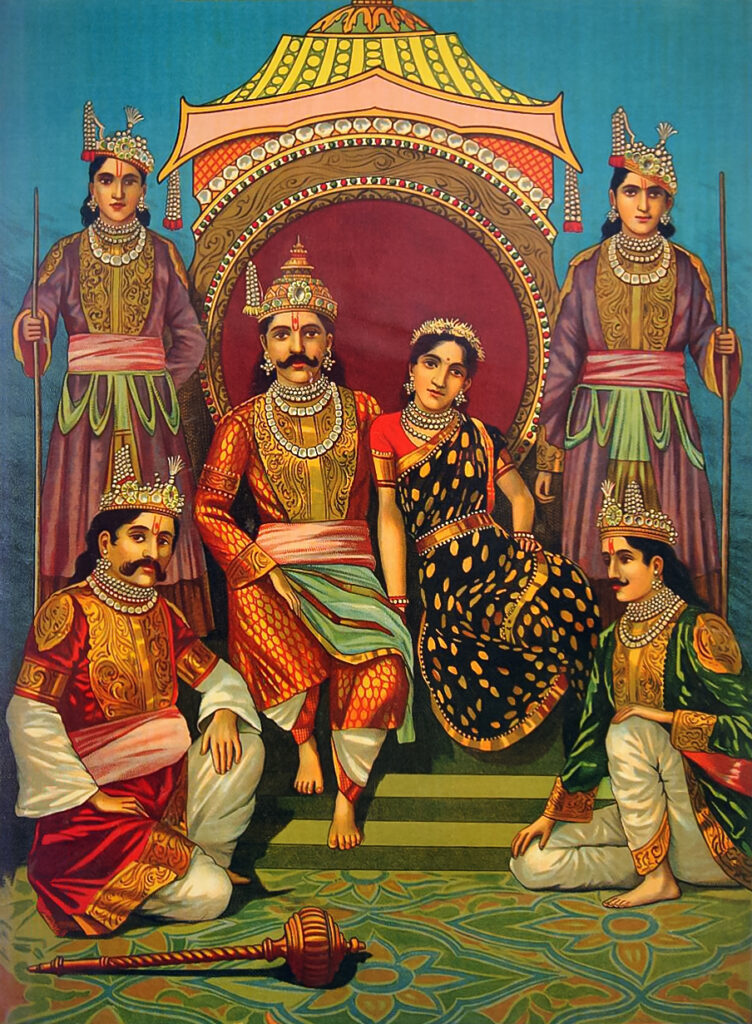
When Draupadi was married to the five Pandava brothers, it was her prophecy and an obligation of the Pandavas to fulfill the commands of their mother. But today, when the women of certain villages of Himachal Pradesh and Uttarakhand marry all the brothers, it is to keep the family land from being divided, and to solve the usual problem of finding a bride in these regions. This practise, locally called ‘Jodidaran’, ‘Draupadi Pratha’, or ‘Pandava Pratha’, has been followed for generations by the people of Sirmaur, Jaunsar-Bawar, Kinnaur, and other villages.
Fraternal polyandry refers to a social arrangement where a woman marries all the brothers of a household. She legally gets married to the eldest brother, but plays the role of wife for the rest of the brothers as well. The word originates from the Greek word ‘polyandria’, derived from ‘poliyandros’, meaning the condition where a woman is together with many men. For centuries, the residents of Jaunsar-Bawar, Kinnaur, and Sirmaur have adopted this lifestyle as a practical solution to prevent land fragmentation and meet the needs of the mismatched male-female sex ratio.
The Mahabharata introduced the concept of polyandry in popular culture. And it also serves as the origin of polyandry in the Himalayan regions. Folktales attribute this practice to the exile episode of the Pandavas, during which they spent a period in the Himalayan region. Arjuna had won Draupadi in a swayamvara when they were living in disguise after escaping the burning house of wax. The Pandavas attended the swayamvara dressed as Brahmanas. After Arjuna brought Draupadi to Kunti and asked her to take a look at what they had brought that day, Kunti ordered them to share it among themselves. She had her back towards the sons and did not see that it was a woman they had brought home and not alms. Bound by their mother’s instructions, they pleaded their situation to Ved Vyasa and Lord Krishna, present at King Drupada’s palace.
Ved Vyasa showed Draupadi her wish to Lord Shiva in her previous birth. She had asked Lord Shiva for “a just husband; …a strong husband; …a brave husband; …a wise husband, and …a very handsome husband.” Lord Shiva, slightly intoxicated, had said ‘yes’ five times to her five demands, inadvertently granting her five husbands, each with a distinct characteristic (1).
The Rig Veda and many other ancient Indian scriptures mention polyandry and a number of its instances. For instance, Goddess Saraswati is depicted as the wife of the Ashvin brothers in the Yajur Veda, of Indra in the Rig Veda, of Vishnu in the Brahma Vaivarta Purana, and of Brahma in the Skanda Purana. At the same time, Hindu scriptures condemn women who have a relationship with more than one man. The Mahabharata calls it sinful for a woman to take a second husband, while the Brahma Vaivarta Purana calls a woman who establishes a relationship with four men a prostitute.
The records of foreign travelers who came to India during the medieval period mention the practice of polyandry and the concept of sharing a woman. Al-Beruni, Ghulam Basit, and Mohammad Qasim Ferishta have written about the existence of polyandry in Punjab and the fact that it was a common practice. They reasoned that this practice was a result of repeated invasions and the absence of men from their houses for a prolonged period due to their military services (2). Earlier British records of the observers and officials write, “It is not uncommon among Jats and lower castes for a woman to be shared in common by several brothers, though she’s recognized as the wife of only the eldest of them (3).” The older generations of these regions recall Draupadi Pratha always being the norm in their society.
In 2025, a marriage ceremony of the Hatti community in Giripar district of Sirmaur took social media by storm. The marriage involved two brothers marrying one woman, with all rituals and in front of all the relatives. The bride had willingly consented to the marriage with both brothers. Ransingh Chauhan, lawyer and legal advisor of the Central Hatti Community, in an interview, said, “Hundreds of marriages happen through polyandry and other age-old traditions….The practice is being done to ensure that families stay united and lands are not divided among themselves (4).” Similarly, in an interview with Sunila Devi of Sirmaur, she narrated how she was asked to become the wife of the younger brother of her husband, for whom she used to pack lunchboxes for school when he was younger. She said, “There was just one woollen sweater and one pair of slippers. So, my mother-in-law and I shared them. When a sweater and a pair of slippers were being shared, I obviously had to be shared (5).”
In most of these cases, women are not consulted, nor their consent taken; they are not informed of the decision beforehand. Most of the village residents are poverty-stricken, with little land or property in their name. Marriage to one woman would ensure fewer claimants to the land and prevent its fragmentation. The scarcity of fertile agricultural tracts in hilly terrain added to this necessity. When the children are born, they consider all the husbands as their fathers and call them with their appropriate designations.
However, with time, the practise is undergoing some changes. Kundan Singh Shastri, a leader of the Hatti community, in an interview, exclaimed that the Draupadi Pratha is destined to die a slow death as the younger generation is increasingly moving to cities (5). The educated women and men of the community are refusing to follow Jodidaran Pratha. Even the parents, especially women, are refusing to allow their children into polyandry. Kundan Shastri has commented that joint marriages (polyandry) do not take place without the consent of the women. In fact, they are respected, and their decisions on family issues are considered when brothers and the elder men are not able to arrive at a decision (5).
In a study of the villages of the Jaunsar-Bawar region (particularly Matiyawa and Mohana), it was seen that in Matiyawa, for every 1000 males, there were 770 females, and for Mohana sex ratio was 900 females for 1000 males. The tribes here call this tradition ‘Pandava Pratha’ and strongly believe they are responsible for carrying forward the legacy of their forefathers (the Pandavas), and hence the reason they practise Jodidaran Pratha (6). According to the epic, when the Pandavas were banished for thirteen years, they spent the last year of their exile hiding in Kinnaur. Rajesh Gill, in her book Gender, Culture and Honour, writes that women married into polyandry are significantly happier compared to women in monogamous marriage. They are referred to as ‘readymade-wives’ and ‘modern-day Draupadis’. Her research shows that these women have never experienced domestic violence (7). Additionally, in case of the death of one of the husbands, she does not become a widow nor left unsupported. She is cared for and supported by her other husbands.
The Himachal Pradesh High Court legally recognizes the fraternal polyandry under the Jodidar Law. The law allows a woman to have more than one husband, despite polyandry being illegal under Indian law and order. But the legal framework of India leaves some room to accommodate the practices of the tribes and safeguard them. In any case, it is hard to determine if the tradition is going to end or continue for more generations.
References
1. Isha Foundation, “Mahabharat Episode 22: Draupadi’s Predicament,” https://isha.sadhguru.org/en/wisdom/article/mahabharat-episode-22-draupadis-predicament
2. Sarva Daman Singh, Polyandry in Ancient India (Delhi: Motilal Banarsidass, 1988), 161-165.
3. Hissar District Gazetteer, 1904 (Lahore, 1908), 65.
4. Times Now, “In Himachal Pradesh’s Sirmaur, A Bride Marries Two Brothers Under ‘Draupadi Pratha,” https://www.timesnownews.com/india/draupadi-pratha-in-himachal-pradesh-sirmaur-a-bride-marries-two-brothers-article-152310852
5. India Today, “Wedded to one brother, but married to many: Poverty and Draupadi Pratha in Himachal,” https://www.indiatoday.in/sunday-special/story/poverty-polyandry-himachal-pradesh-villages-draupadi-pratha-jodidaran-sirmaur-hatti-tribe-2550792-2024-06-09
6. Centre for Development Economics at Delhi School of Economics, “A Polyandrous Society in Transition: A CASE STUDY OF JAUNSAR-BAWAR,” http://cdedse.org/wp-content/uploads/2018/06/3-2.pdf
7. ThePrint, “No domestic violence when brothers share ‘wife’ — book dwells on ‘Draupadi pratha’ bliss,” https://theprint.in/feature/no-domestic-violence-when-brothers-share-wife-book-dwells-on-draupadi-pratha-bliss/317933/