The land of mysterious pyramids opened the largest archaeological museum in the world, the Grand Egyptian Museum (GEM), and we cannot keep calm! The museum traces the rich history of Egypt from its prehistory to ancient times to the end of the Roman period. It houses over 100,000 artefacts that represent approximately the history of seven millennia. The highlight of the museum is two galleries dedicated solely to the burial contents unearthed from the tomb of the Pharaoh Tutankhamun, the youngest ruler of ancient Egypt, by the British-Egyptologist Howard Carter in 1922. It is the first time the entire collection of artefacts from his coffin has been housed under one roof since its discovery.
The idea for the GEM was conceived in 1992, when a large tract of land was purchased near the pyramids of Giza. An architectural competition was held in 2002, and applications were invited from top-notch architectural companies for the project. Over 1,500 applications poured in from around the globe, and the Irish company Heneghan Peng Architects won the competition. The foundation stone of the museum was laid in 2002, and the project was finally opened to the public in 2025, after being postponed several times.
The GEM reimagines the cultural heritage and ancient stories of Egypt. It uses advanced technology and interactive methods to make history accessible and interesting. The museum offers a Mixed-Reality Experience that allows you to discover the origins of the Khufu pyramids and unravel their well-kept secrets. It effectively blends innovation and knowledge to create a memorable experience. Similarly, its various sections use interactive technology and hands-on experience to change how visitors experience museums. An online survey conducted by the University of Glasgow from March to June 2024 included 1047 participants to understand the impact of using digital technology to access or view cultural heritage in museums. The survey results showed that 72% of people felt that the use of virtual reality in cultural heritage would be valuable for attracting visitors to museums. Another 38% reported that they would, probably or definitely, pay for virtual cultural heritage experiences (1).
Museum Sections
GEM Children’s Museum: GEM breaks the stereotype and takes a step forward to make museums and history relevant, fun, and educational for kids. It allows children to become a part of the Egyptian heritage rather than just observe from a distance. It uses curriculum-based learning experiences, multi-generational dialogue, self-directed learning, and integrated technology to promote cognitive, social, and emotional development.
GEM Education Centre: Here, students and adults could exchange ideas and information on Egyptian heritage and culture. It introduces history through diverse perspectives and establishes a link between the past and the present, and people across cultures. It aims to advance the future of education by integrating past and its learnings with the present.
Arts and Crafts Centre: The GEM website describes this centre as a place “where ancient craft meets contemporary creativity (Grand Egyptian Museum).” It is a dynamic space where traditional craftsmanship meets modern and cutting-edge technology. It encourages the artists and designers to adapt ancient Egyptian crafts and art into their designs, makes the Egyptian culture accessible to the local public, and allows hands-on experience of creating the ancient craft.
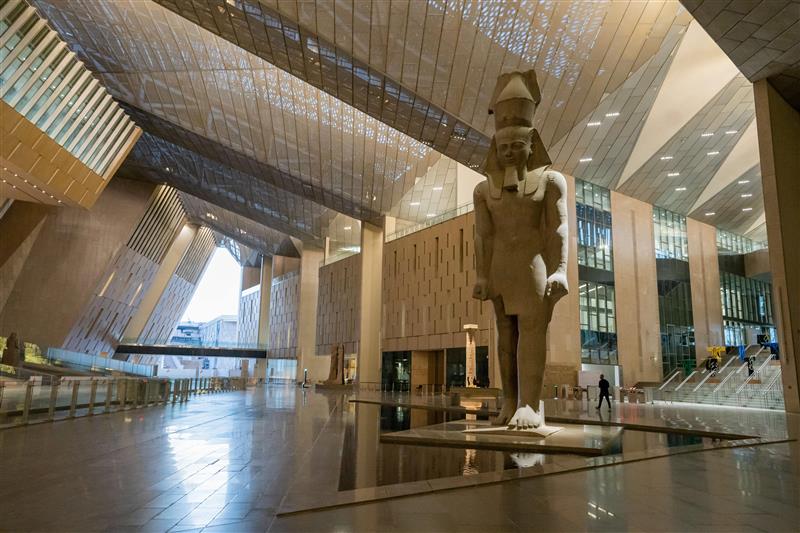
The archaeological museum spans 500,000 square meters, housing the Grand Hall, Grand Stairs, 12 main halls, a hanging obelisk, and a Khufu’s Boats Museum. The Grand Hall or the Atrium of the Grand Egyptian Museum is the main entrance hall. It has a glass roof and transparent façade, from where the Pyramids of Giza are visible. An 11-metre-tall statue of Pharaoh Ramesses II or Ramesses the Great (third pharaoh of the Nineteenth Dynasty of ancient Egypt, 1303 BCE – 1213 BCE (2)) stands in the hall along with other colossal statues and royal artefacts.
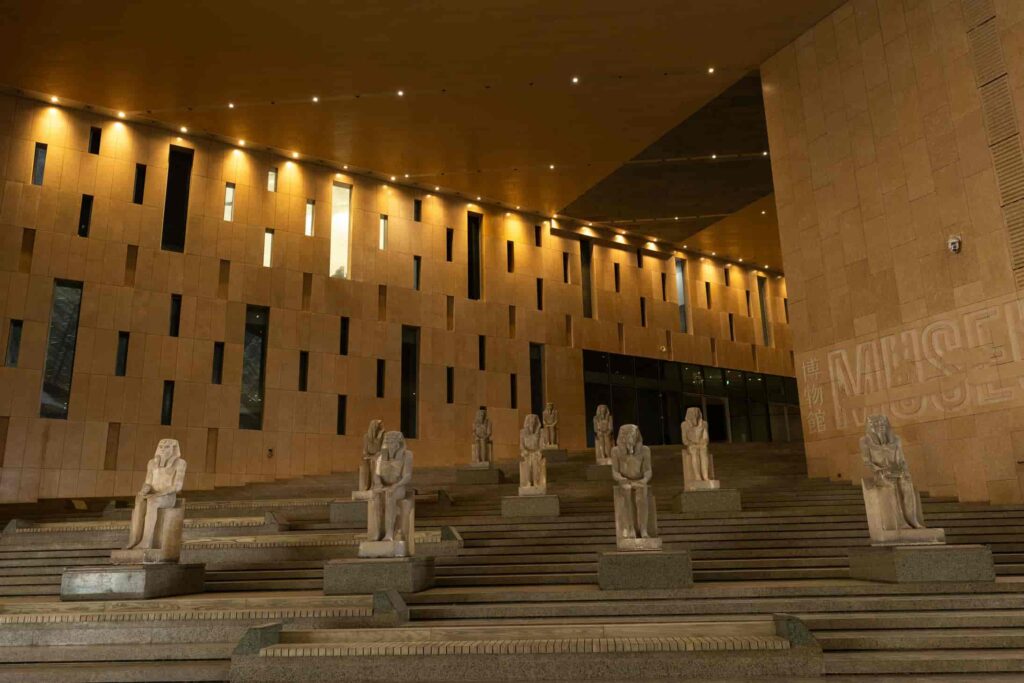
The Grand Hall leads to the Grand Stairs, where large statues of pharaohs, gods, and goddesses overlook the visitors. It is divided into four sections – Royal Image (Portrayal of pharaohs as royal statues), Divine Houses (temple architectural marvel of ancient Egypt), Gods and Kings (divine connection of the rulers with the Gods), and Journey to Eternity (funerary customs and objects).
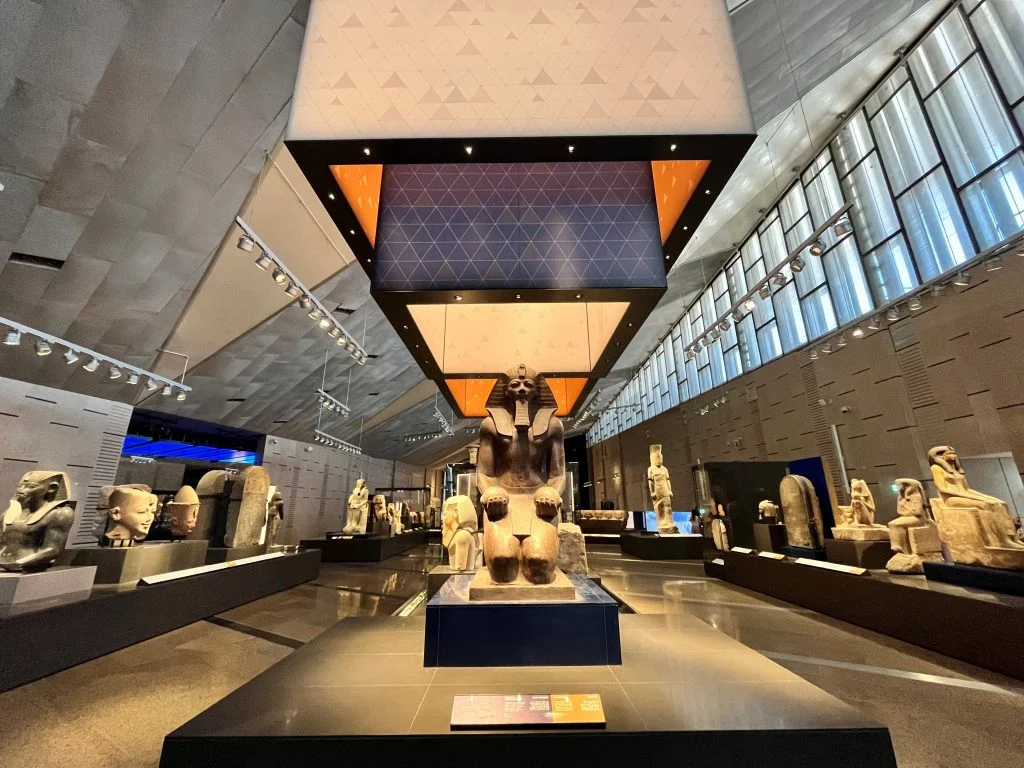
The Grand Stairs serves as an entrance for the 12 main halls, including the Tutankhamun galleries. These galleries display the artefacts from all the centuries of the ancient Egyptian civilization. The galleries are chronologically divided into historical time periods, starting from ancient times and ending with the Roman and Greek periods of Egypt. Some of the artefacts housed here include the statuette of a falcon belonging to the Late Period and the Twenty-Sixth Dynasty found in Sais, a gilt hawk figure of the Graeco-Roman period unearthed near the Dendera temple and part of Dendera Treasure Hoards, a golden necklace decorated with ornaments and pendants from the Graeco-Roman period discovered in Dendera, and a bronze mirror of Egyptian governor Mesehti of Eleventh Dynasty and New Kingdom found at Asyut.
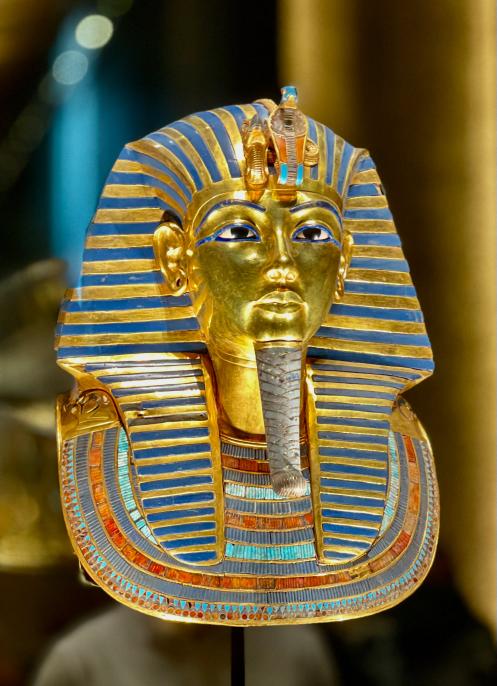
The Tutankhamun galleries display the funerary content of the tomb of the Golden Pharaoh. The main attraction includes his Golden Burial Mask and his golden throne. The Gold Mask was found covering the head and shoulders of the mummy of King Tut. The mask represents the god of the underworld Osiris, the sun god Ra, and the actual facial features of Tutankhamun. An inscription on the back of the mask reads “Your forehead is Anubis, your right eye is the night boat (of Re), your left eye is the day boat, your eyebrows are in the company of nine gods (Grand Egyptian Museum).”
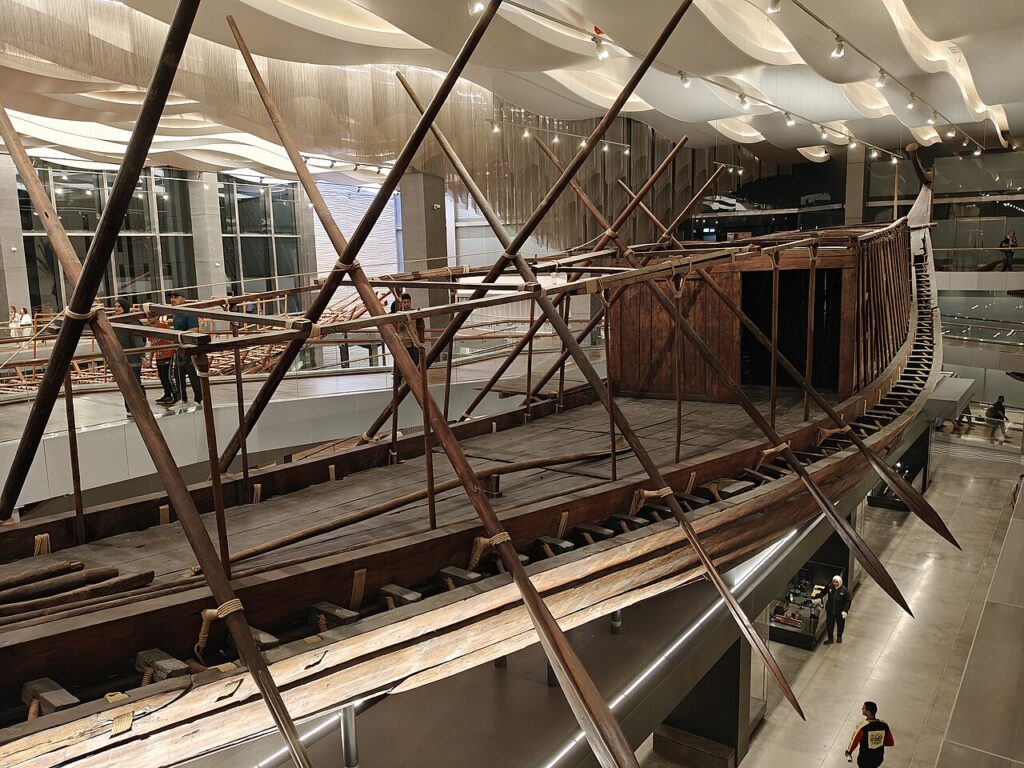
The next segment in the GEM is the Khufu’s Boats Museum that houses the life-size boats of the Pharaoh Khufu or Cheops (second pharaoh of the Fourth Dynasty of the Old Kingdom). It was discovered in the boat pits of the funerary complex of the latter at the Great Pyramid of Giza. The boats were carefully assembled to their full size and transported to the GEM only in 2021. They are the oldest intact ships in the world and are categorised as a masterpiece of woodcrafting. These boats were solar barges, a ritualistic vessel that the ancient Egyptians believed would carry the deceased ruler to the heavens.
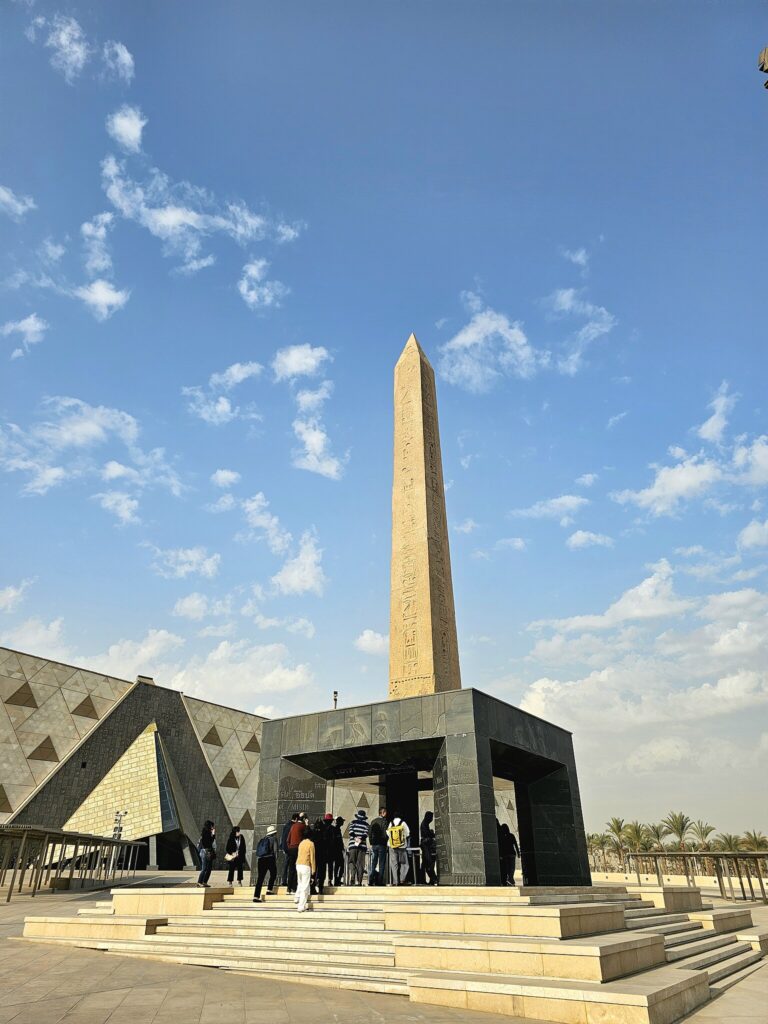
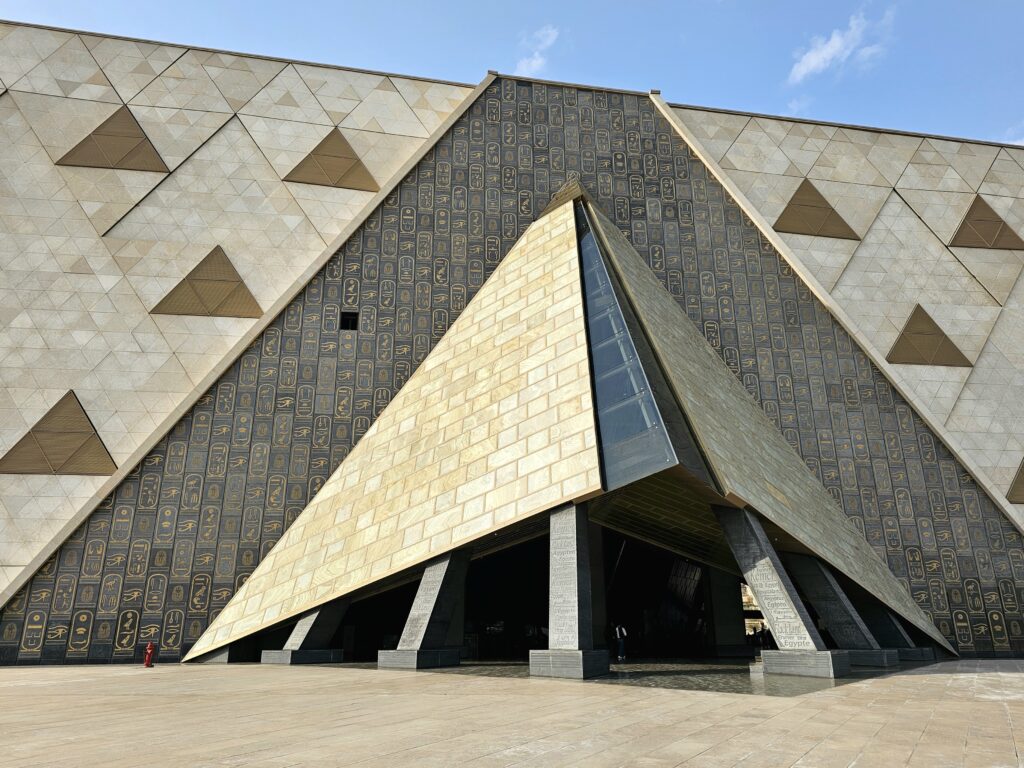
At the entrance of the museum, the visitors witness a magnificent view of the hanging obelisk. This obelisk was raised by Ramesses II at Tanis along with nine others. Of the ten obelisks, this was the tallest, standing at 16 meters high. It was relocated from the Eastern Delta to the site of the museum to make it the first artefact visitors see as they enter the Grand Egyptian Museum complex. The obelisk is made of granite and weighs 87 tons; it is placed on a 30,000 square meters square platform supported by four pillars, making it the first ‘hanging’ obelisk in the world. On the four sides, you can see the Horus name, the throne name, and the birth name of the pharaoh. The visitors can pass through the raised platform and see the hidden cartouches of Ramesses II on the bottom of the obelisk. Moving ahead, at the non-conventional entrance gate of the museum, you can view the symbols of the Eye of Horus, the Tutankhamun mask, and Egyptian hieroglyphs.
The Grand Egyptian Museum is a landmark in the ancient history and archaeology of Egypt, and the way the world views museums. It not only displays a huge collection of ancient artefacts but also takes sustainable steps to preserve its cultural heritage digitally. It uses modern technology to document the archaeological collections inside the museum. A research report on GEM showed that there was no system in place in Egyptian museums for digital documentation and preservation of the cultural heritage of the period. The GEM documentation initiative, in cooperation with international students, developed ‘solutions for the digital preservation of Egypt’s cultural heritage (3).’ A survey of museum collections in museums under the Egyptian Ministry of Tourism and Antiquities showed that about 82% of national museums display ancient Egyptian collections, while only 18% museums focus on artefacts from other historical periods (4).
The famous archaeological museum is also a platform to discuss the issues concerning Egyptian culture and heritage. The key demands of the professionals include the return and repatriation of looted items. In an interview with BBC, Dr. Zahi Hawass, former minister of tourism and antiquities of Egypt, mentioned, “Now I want two things: number one, museums to stop buying stolen artefacts and number two, I need three objects to come back: the Rosetta Stone from the British Museum, the Zodiac from the Louvre and the Bust of Nefertiti from Berlin (5).” In response, the British Museum cited the absence of any formal request from Egyptian officials and the inability to return objects permanently bound by the British Museum Act of 1963, which restricts the return of objects.
The GEM has opened as a bid to increase tourism in Egypt and as a response to the advancement and increasing awareness of the nation towards its culture and heritage. The attempt of the museum to revive and reacquire lost national treasures remains its most prominent demand among others.
Sources
Grand Egyptian Museum, https://gem.eg/en/
1. University of Glasgow, “Museums in the Metaverse Audiences and Impact Report”, https://www.gla.ac.uk/media/Media_1138224_smxx.pdf
2. Rosicrucian Egyptian Museum, “Ramses II”, https://egyptianmuseum.org/explore/new-kingdom-ruler-ramses-ii
3. ResearchGate, “Digitization and the Collection Sustainability: Report on the Grand Egyptian Museum Project, Egypt”, https://www.researchgate.net/publication/381156219_Digitization_and_the_Collection_Sustainability_Report_on_the_Grand_Egyptian_Museum_Project_Egypt
4. MDPI, “Distance Learning through the Grand Egyptian Museum: Leveraging Modern Technology to Teach about Ancient Egypt among Schools and National Museums”, https://www.mdpi.com/2227-7102/14/7/714
5. BBC, “Egypt’s Grand Museum opens, displaying Tutankhamun tomb in full for first time”, https://www.bbc.com/news/articles/ckg4q403rpzo